Supporting Cross-lingual Communication in Globally Distributed Teams
Context 🧭
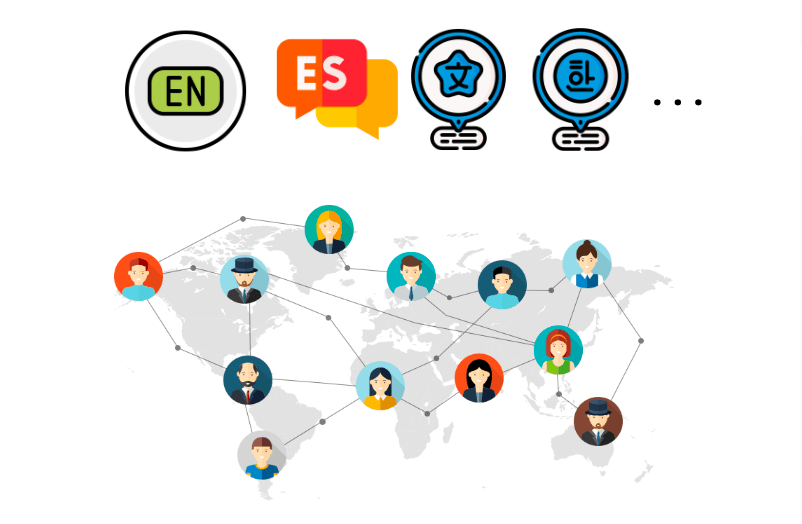
In today’s global organizations, cross-national teams are increasingly common. These teams often consist of subgroups located in different countries, each with their own local languages and cultural contexts. While English is frequently used as the shared language for work, teams often face challenges in exchanging local contextual knowledge across subgroups.
One recurring issue is the limited sharing of local information before global meetings—often due to language barriers. Prior research has shown that frequent and effective communication of local insights is closely linked to stronger team performance and collaboration quality.
With the rise of machine translation (MT) tools, a timely question emerges:
Can we use MT tools to help globally distributed teams exchange contextual information before meetings—across language boundaries?
Research Questions 🔍
- How does the use of machine translation to share subgroup conversation logs influence teamwork in globally distributed teams?
- Do the effects of MT-mediated communication vary based on the native language of the subgroups (e.g., English vs. Mandarin)?
Goal 🎯
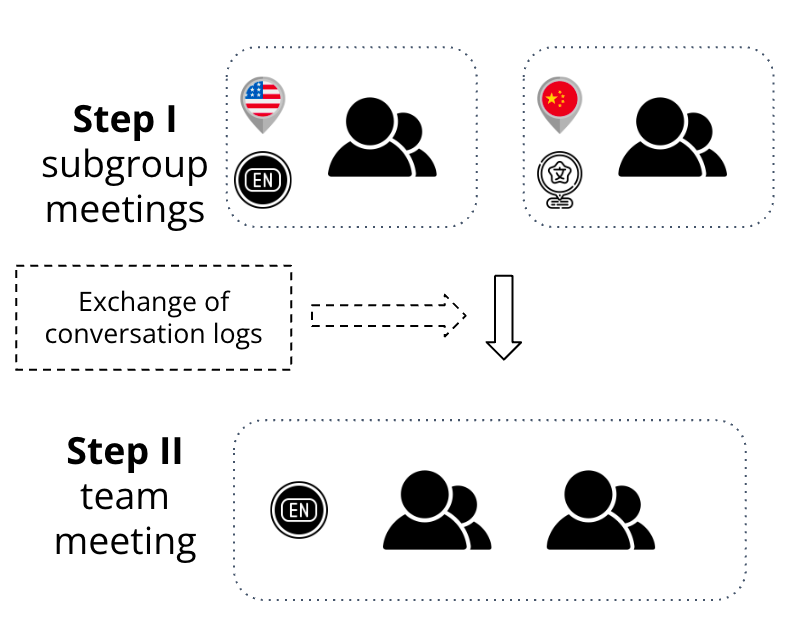
This study aimed to examine the effects of MT-supported exchange of subgroup conversations on team collaboration performance in globally distributed teams.
The broader goal is to inform the design of low-cost, scalable technology solutions that enable better cross-lingual communication and knowledge sharing within global organizations.
Method 🧪
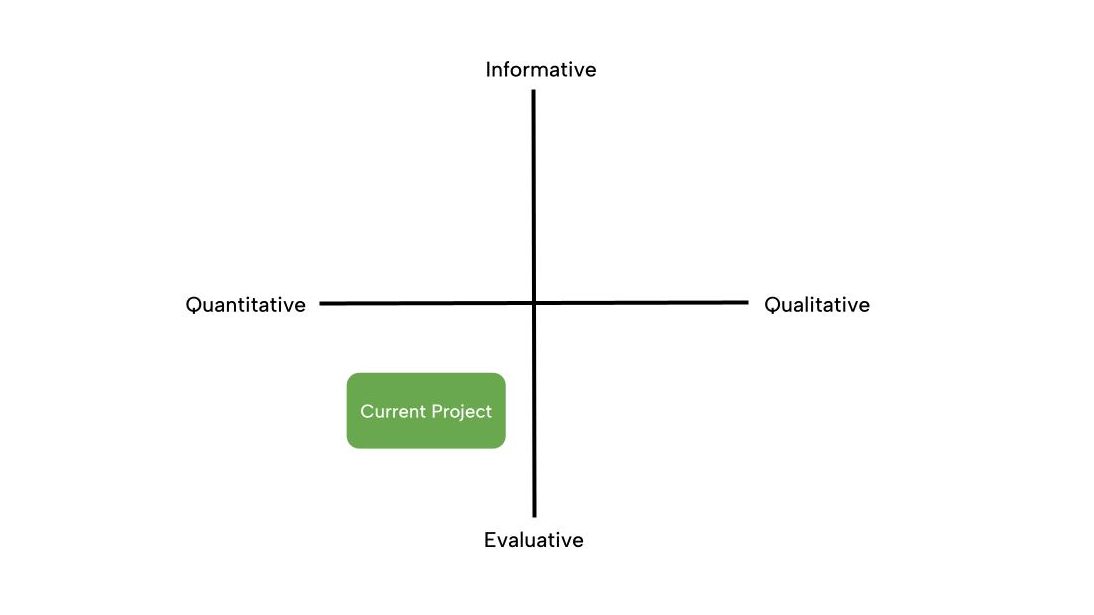
To evaluate the effect of machine translation on team collaboration, I conducted a controlled online experiment. This method allowed us to systematically compare team performance with and without MT-supported conversation sharing in a simulated global teamwork setting.
Outcome 📝
- Presented findings remotely at multiple venues such as CSCW and UMD HCIL symposium attended by researchers across disciplines and industry practitioners.
- Published at ACM CSCW 2022, the premier conference for Human-Computer Interaction research.
Team 🤝
This project was led by Yongle in collaboration with a multidisciplinary team:
- One Ph.D. student in Computer Science, who supported the development and testing of in-house machine translation systems and APIs.
- One undergraduate student in Computer Science, responsible for building the task interface system.
- One graduate student in Information Science, who assisted with data collection and participant coordination.
- Supervised by faculty advisors from both the Computer Science and Information Science departments.
I was responsible for designing the research framework and experimental conditions, leading the data collection process, and conducting quantitative analysis to evaluate how machine translation influenced cross-lingual team collaboration.
Impact 🌍
- Contributed concrete quantified evidence for the role of machine translation in improving global team collaboration.
- Supported the case for integrating lightweight, cost-effective MT tools into existing enterprise platforms.
- Influenced future research directions on multilingual workplace communication and AI-driven collaboration.
Study Procedure
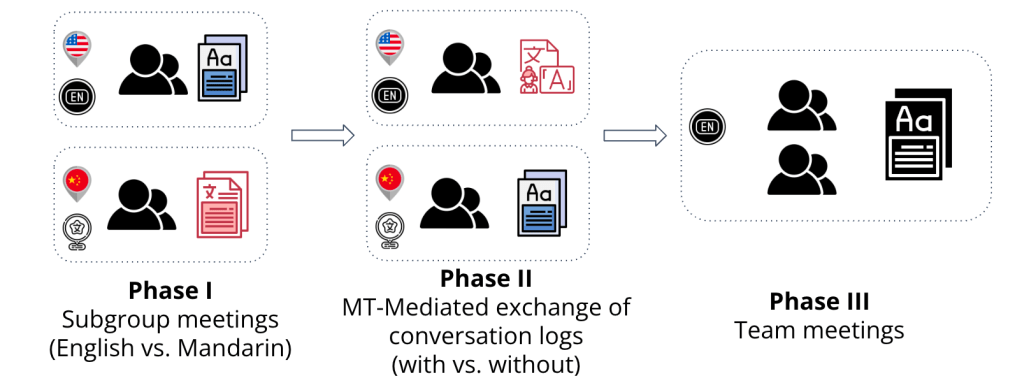
I used an experimental design to closely simulate real-world global team dynamics. 80 Participants were placed into remote four-member teams, each consisting of two native English speakers and two native Mandarin speakers.
Teams completed a group decision-making task in two stages using instant messaging. First, participants communicated in language-based subgroups (English or Mandarin) using their native language. Then, all four members joined a team-wide meeting conducted in English, the shared working language.
To isolate the impact of machine translation (MT), I manipulated whether subgroups had access to translated content before the team meeting. In the experimental condition, participants reviewed machine-translated transcripts of the other subgroup’s conversation.
Teamwork effectiveness was assessed across multiple dimensions:
- In-task survey responses measuring their task experience, such as communication quality, comfort and workload.
- Team’s final decision as an objective performance measure.
- Log data capturing their meeting transcripts.
This mixed dataset allowed for both behavioral analysis and quantitative comparison across user groups.
Key Findings and Implications 🔍

- Improved communication experience: Participants in the machine translation condition—regardless of native language—reported greater clarity and comfort when communicating across subgroups.
- Higher task performance: 4 out of 10 teams in the MT condition correctly identified the most qualified candidate, compared to 0 teams in the baseline condition.
- No added cognitive load: Reviewing translated conversations did not increase participants’ perceived workload.
- Richer meeting discussions: Teams with MT support shared more detailed reasoning and contextual information during team meetings.
These insights suggest valuable design insights: MT tools, when used strategically, can help close this gap and support more inclusive, effective teamwork across languages.
- Support team-level grounding: Machine-translated conversation logs can enhance shared understanding by prompting team members to consider perspectives not present in their subgroup discussions.
- Leverage MT beyond real-time chat: This study highlights the potential of using MT for asynchronous review of subgroup conversations—a low-effort alternative to live translation that still improves communication outcomes.
 Yongle Zhang | 张永乐